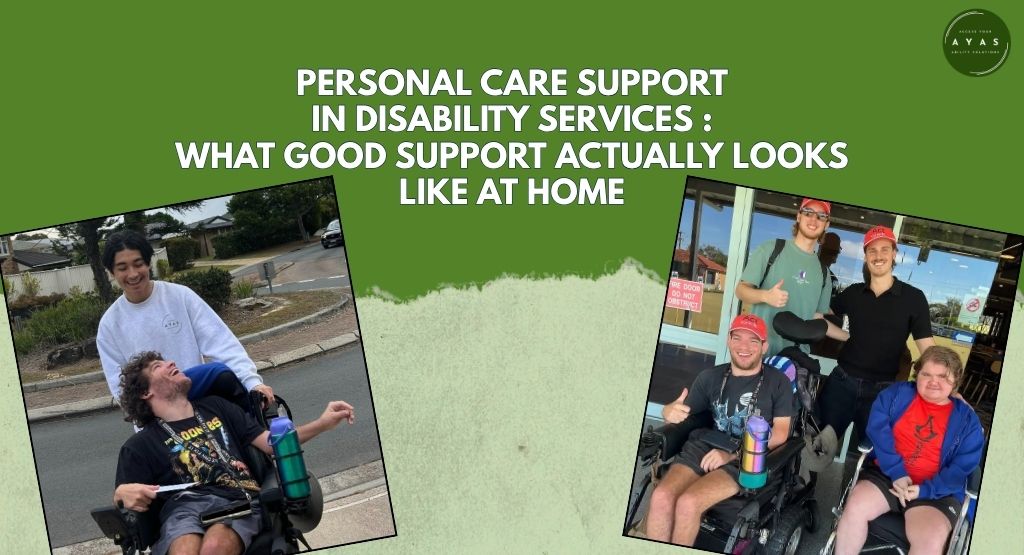
What personal care support actually looks like
Personal care support in disability services is more than just helping with daily tasks like showering or getting dressed.
It’s about how those tasks are delivered.
On the Gold Coast, good personal care support should feel:
- Respectful
- Consistent
- Comfortable
- Tailored to your routine
If support feels rushed, awkward, or inconsistent, that’s usually a sign the quality isn’t where it should be.
What personal care support actually includes (with real examples)
Personal care support can include:
- Showering and hygiene
- Getting dressed
- Grooming (hair, shaving, brushing teeth, trimming nails etc)
- Toileting support (Assistance with urine bottles, catheters etc)
- Mobility assistance (Pivot transfers, hoist transfers etc)
- Support getting in and out of bed
- Meal preparation support
- Medication reminders (within scope)
🔍 Real example (morning routine)
A support worker arrives at 7:30am.
A good approach:
- Greets you properly, checks how you’re feeling
- Asks what you’d like to do first
- Supports you through your routine at your pace
- Adjusts if you’re tired or sore
A poor approach:
- Rushes straight into tasks (totally fine if that is how you prefer and the goal)
- Doesn’t check how you feel
- Treats it like a checklist
Same tasks, completely different experience
Why personal care support is so important
This type of support impacts:
- Confidence
- Mental wellbeing
- Routine stability
- Independence
Real example (confidence impact)
If support is respectful:
You feel more comfortable asking for help
You build trust
Your routine improves
If support is rushed or uncomfortable:
You avoid support
You feel stressed
Your routine breaks down
That’s why this is one of the most important areas to get right.
What GOOD personal care support looks like
1. Dignity and respect at all times
This means:
- Doors closed
- Privacy respected
- Consent always asked
Example:
“Are you comfortable if we do this task now?”
Instead of just doing it.
2. Support is adjusted to how you feel that day
No two days are the same.
Example:
- High pain day → slower routine, more support
- Good day → more independence encouraged
Good support adapts.
3. Clear and calm communication
You should always know:
- What’s happening
- What’s next
- What your options are
Example:
“Would you like to shower first or need the loo first?”
4. It feels natural, not clinical
Support should feel like part of your life.
Not a process.
5. Independence is still encouraged
Good support workers:
- Let you do what you can
- Step in when needed
- Build confidence over time
What poor personal care support looks like
Watch for:
- Being rushed
- No communication
- Ignoring your preferences
- Feeling uncomfortable
- Lack of consistency
Real example:
- Worker doesn’t ask how you feel
- Rushes through shower
- Leaves quickly
This builds frustration fast
First month checklist:
Use this after starting support:
Comfort
- Do I feel comfortable during support?
- Do I feel respected?
Routine
- Is my routine being followed?
- Is support consistent?
Communication
- Am I being asked and listened to?
- Do I feel heard?
Pace
- Am I rushed?
- Can I go at my speed?
If multiple answers are “no” → address early. Good support teams action feedback quickly.
Family perspective (important addition)
If you’re a family member, watch for:
- Behaviour changes
- Avoiding support
- Increased stress
- Short answers or withdrawal
Example:
Someone who used to be fine with support now avoids it
That’s usually a sign something wasn’t right with the last company.
How this connects to daily living support
Personal care is part of the broader daily living support services’ on the Gold Coast (Core Support)
It often overlaps with:
- Household support
- Routines
- Appointments
- Community access
(Internal link opportunity to Blog 4 + Services page)
Gold Coast-specific considerations
On the Gold Coast when receiving disability support a provider must consider:
- Travel between suburbs
- Timing and consistency
- Flexibility matters
A good provider should:
- Manage scheduling properly
- Provide consistent workers
- Adapt to routine changes
The difference between average and high-quality support
Average:
- Tasks completed
- Minimal communication
High-quality:
- Builds trust
- Supports independence
- Adapts daily
- Feels comfortable
- Assists with tasks
Final thoughts
Personal care support is one of the most important parts of disability support.
Because it affects how you feel every single day.
It should feel:
- Respectful
- Calm
- Consistent
- Comfortable
If it doesn’t, something needs to change.
Key takeaway
Personal care support is not about tasks
It’s about experience, comfort, and trust
FAQ
What is personal care support in the NDIS?
It is included in the ‘core support’ of NDIS funding. It can be support that helps with daily hygiene, dressing, grooming, and routines under daily living support.
Can I change my support worker in the NDIS?
Yes. If the fit isn’t right, you can request a different worker.
Is personal care part of daily living support?
Yes, it often sits under core supports in your NDIS plan.
If you’re looking for personal care support on the Gold Coast that feels consistent, respectful, and tailored to your routine, AYAS can help you understand what that should look like before anything starts.