
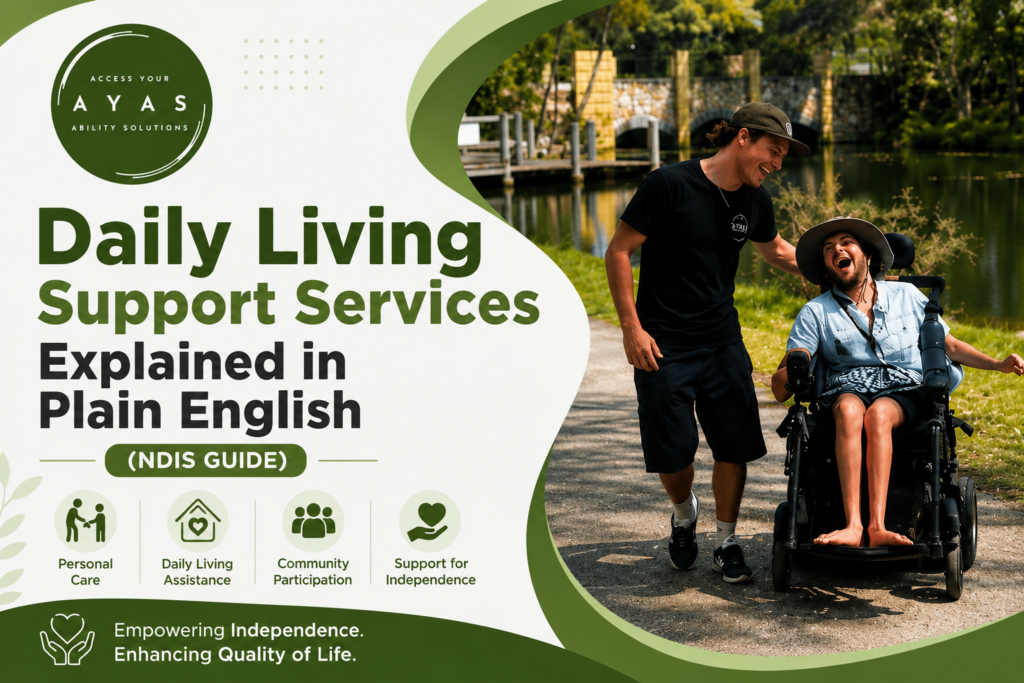
What daily living support actually means (real answer)
Daily living support services under the NDIS are designed to help people manage everyday life in a way that feels stable, safe, and independent.
In plain English, it’s the support that helps everything else in life run properly.
This can include things like getting ready in the morning, managing a household, attending appointments, or building routines that allow someone to function day-to-day. This could also include assisting with showers, personal care, meal preparation, cleaning, getting to the hospital, and also can be used (in some cases) for getting to an event or function (Also can be under Community Participation Support). On the Gold Coast, where people often balance home life with community access, work, and appointments across different suburbs, daily living support becomes the foundation that keeps everything consistent.
The key thing to understand is this:
Daily living support is not only just “extra help.” It is often the structure that allows someone to maintain independence and quality of life. Support that fits your routine.
Where daily living support fits within the NDIS
Within the NDIS, daily living support sits under Core Supports, which are designed to assist with everyday activities and participation.
NDIS Core support is intentionally flexible. That means funding can often be used across different types of daily assistance depending on what is needed most at the time. For example, support may shift between help at home, community access, or routine-based assistance depending on how someone is feeling or what their week looks like.
This flexibility is important, because no two participants use daily living support in exactly the same way. One person may rely heavily on support at home, while another may need more help staying organised, attending appointments, or maintaining a weekly routine.
What daily living support actually looks like in real life
The easiest way to understand daily living support is to look at what it looks like across a normal week.
For some people, it begins with the morning. A support worker may assist with getting out of bed, organising the day ahead, preparing breakfast, or helping with basic hygiene and dressing. This is not about taking over, it is about making the start of the day smoother and more manageable.
During the day, support might shift into household tasks. This could involve cleaning, laundry, organising the home, or preparing meals for later. These tasks might seem simple, but when they are not managed consistently, they can quickly impact someone’s ability to function comfortably in their own space.
There are also practical tasks that sit in the middle of daily life, such as attending appointments, shopping, picking up items from post office/medication, managing errands, or keeping on top of responsibilities. On the Gold Coast, where travel between suburbs can be a factor, this kind of support becomes even more important. Having someone reliable to assist with timing, transport, and organisation can reduce stress significantly.
Evenings may involve showers, toileting assistance, winding down routines, preparing meals, or setting up for the next day. These smaller moments often go unnoticed, but they are where long-term stability is built.
How daily living support is different from personal care
Daily living support and personal care often overlap.
When asking a provider for support you can state what support should look like for you. Personal care focuses more on direct physical support, such as hygiene, grooming, or toileting. Daily living support is broader. It includes the structure around someone’s life, such as routines, environment, organisation, and participation in everyday tasks.
For example, helping someone shower is specifically known as personal care. Helping them build a consistent morning routine, organise their day, and maintain their home is daily living support.
Both are important, but daily living support is the umbrella for all general support and is often what connects everything together.
Why daily living support is so important for independence
One of the biggest misconceptions is that daily living support creates dependence.
In reality, when done properly, it does the opposite.
Good support helps people:
- Build routines
- Stay organised
- Reduce overwhelm
- Maintain consistency
- Increase confidence in daily tasks
For example, someone who struggles to keep up with household tasks might feel constantly behind. Over time, this can lead to stress, avoidance, and loss of confidence. With the right support in place, those same tasks become manageable, predictable, and less overwhelming.
Independence is not about doing everything alone.
It is about having the right level of support to function well.
What high-quality daily living support looks like
High-quality support is not defined by how many tasks are completed, but by how well it fits into someone’s life.
A good support worker will take the time to understand how a person prefers to do things. They will adapt their approach based on energy levels, mood, and routine. They will not rush through tasks or treat the shift as a checklist.
Instead, they will contribute to the overall flow of the day.
For example, rather than simply cleaning the house, a good support worker will involve the participant where appropriate, helping them build skills and confidence over time. Rather than just preparing a meal, they may support planning, organisation, and consistency around eating habits.
This is what separates basic support from meaningful support.
What to watch for in the first few weeks of support
The first few weeks are where patterns start to form.
It is important to pay attention to how support actually feels during this time.
If daily living support is working well, things should start to feel easier. Routines become more predictable, tasks feel more manageable, and there is a sense of stability.
If something is not right, it usually shows early.
This might look like:
- Support feeling rushed or inconsistent
- Tasks being completed without consideration of preferences
- Poor communication
- Lack of structure or routine
These issues are worth addressing early, before they become long-term problems.
Gold Coast-specific considerations
Daily living support on the Gold Coast comes with its own practical factors.
Travel between suburbs can affect scheduling, especially when support includes appointments or community access. A provider needs to be organised and realistic about travel time, not overbook or rush between clients.
There is also a strong mix of home-based and community-based support in this region. Many participants are not just receiving support at home, but also out in the community. That means support needs to be flexible and well-coordinated.
A provider who understands local routines, traffic patterns, and scheduling realities will deliver a much smoother experience than one who does not.
How daily living support connects to the bigger picture
Daily living support is often the foundation for everything else in an NDIS plan.
It can support:
- Personal care routines
- Community participation (also can be under community participation)
- Appointments and responsibilities
- Skill-building and independence (also can be under improved daily living skills)
Final thoughts
Daily living support services are not just about helping with tasks. They are about creating structure, stability, and confidence in everyday life.
When support is done well, it reduces stress, improves routine, and makes daily life feel more manageable.
When it is not done well, even simple things can become difficult.
The goal is not to do everything for someone.
The goal is to support them in living their life in a way that feels consistent and manageable.
FAQ
What are daily living supports under the NDIS?
Daily living support services are supports that help with everyday activities such as routines, household tasks, and managing daily life. It can be used flexibly.
Is daily living support flexible?
Yes, it is usually funded under Core Supports, which allows flexibility depending on needs.
Can daily living support include community access?
Yes, depending on the participant’s plan and goals. (Yes but also there is a specific community access funding called community participation)
If you’re looking for daily living support services on the Gold Coast that actually fit into your routine and make life easier, our team at AYAS can help you understand what that should look like before anything starts.